
Contents
Although it may seem contradictory, the brands that sell the most cars in the world are not necessarily the ones that make the most money. Generalist brands like Ford, Renault, or Peugeot can sell millions of cars each year. However, those manufacturers that possess certain intangibles enjoy better profit margins, as would be the case with firms like BMW, Jeep, or Ferrari on the more extreme side.
For this same reason, vehicle manufacturers usually have multiple brands in their portfolios. If we take the Stellantis conglomerate as an example, we will see that they have very varied brands, with Fiat and Citroën as low-cost car firms; Opel and Peugeot as generalists; DS and Alfa Romeo as premium; and Maserati in the luxury segment.
A review of the Japanese premium segment

The strategy of combining brands intended for different audiences has been key for the European and American industries. The Japanese did not do it this way, as they have their own peculiar ways of doing marketing. Their culture has always invited them to sell products under a single brand. And that is a problem on a global level. A Japanese person would buy a luxury Toyota, but a Westerner would not be willing to do so.
In the 1980s and 1990s, the main Japanese manufacturers did not want to miss this opportunity, and launched their premium brands:
- Honda was the first to take the step, launching its Acura brand in 1986. The idea was to sell sports cars, but with better finishes. The first ones to see the light with this emblem were the Legend and the Integra.
- Nissan did so with Infiniti in 1989, aiming primarily at the US market. The brand debuted with models like the Infiniti Q45, which featured a V8 engine and a luxurious interior, setting a new standard for luxury sedans that they could hardly have passed off with the Nissan badge.
- In the same year, Toyota launched Lexus, also with the American public in its crosshairs. Build quality was the hallmark of this brand, which gained a very good reputation right with its first model, the LS 400.
- Lastly, we have Eunos, an experiment that Mazda also made in 1989, but which did not quite pan out.
What was Mazda’s goal with Eunos?

The 1980s were golden for the Japanese automotive industry. Japanese vehicles sold very well in the United States due to their low cost, and even more so thanks to their great performance-to-fuel-consumption ratio.
As we were saying, the Japanese would end up copying that Western strategy of having multiple brands in their portfolio to cater to different audiences. Now that more than 3 decades have passed, we can say that the move did not turn out entirely well for them, as the Japanese have never been able to separate their brands the way a Western manufacturer like General Motors or FCA would. However, the vast majority of these Japanese brands still exist to this day.
In any case, Mazda’s move was somewhat peculiar. Eunos was born from a combination of the Greek words “eu” (good) and “nos” (mind), reflecting the focus on providing a pleasant and sophisticated driving experience.
Its logo was also different, moving away from Mazda’s traditional emblem. The idea they defended was that their symbol would help differentiate Eunos models from conventional Mazda vehicles. The Eunos emblem was a modern and elegant design, intended to attract consumers looking for a touch of exclusivity and prestige in their vehicles.
What cars were sold under the Eunos brand?
Eunos was on the front line for barely 7 years. However, it left us a good legacy of models that we will review below.
Eunos Roadster (Mazda MX-5 Miata)

Internationally known as the Miata or Mazda MX-5, this convertible sports car became an icon thanks to its attractive design and agile handling. Of the entire Eunos lineup, you could say it was the best-selling one.
- Launch: 1989
- Key features: Lightweight, rear-wheel drive, 1.6 and 1.8 engines, design inspired by classic British roadsters.
- Impact: It revolutionized the small sports car segment, being one of the best-selling convertibles of all time.
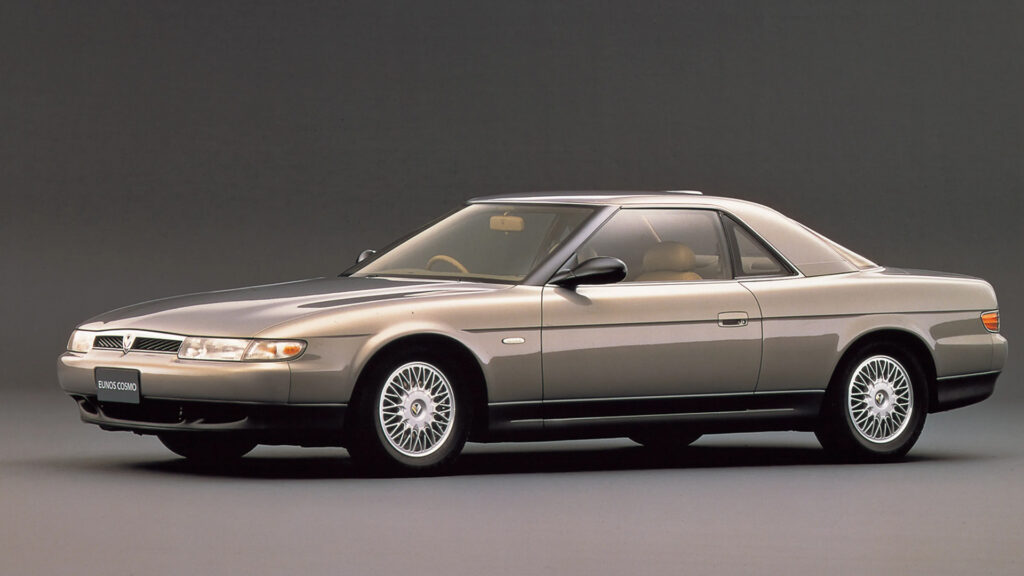
Eunos Cosmo

The Eunos Cosmo was a grand tourer (GT) that stood out for its advanced technology as well as its interior luxury. As a curiosity, it was one of the first cars to incorporate a GPS navigation system. If there is an undervalued JDM, that was the Eunos Cosmo.
- Launch: 1990
- Key features: Rotary engines, including the triple-rotor 20B-REW engine, luxurious interior with advanced technology, GPS navigation system.
- Impact: Known for being one of the most technologically advanced models of its time and for its triple-rotor rotary engine. However, in Japan, the car had many problems because it did not comply with emissions regulations.
Eunos Presso

The Eunos Presso, known in other markets as the Mazda MX-3, was a compact sports coupe that offered a fun driving experience and a design very much in line with what was fashionable at the time.
- Launch: 1991
- Key features: 1.8 V6 engine, compact and sporty design, front-wheel drive.
- Impact: It was a very agile car thanks to its small V6 engine, chassis lightness, and steering.
Eunos 500

The Eunos 500, also known as the Mazda Xedos 6 in some markets, was a mid-size luxury sedan that offered a combination of style, comfort, and performance.
- Launch: 1992
- Key features: 1.6 and 2.0 V6 engines, high-quality interior, elegant design.
- Impact: It stood out for its sophisticated design and its focus on driver and passenger comfort.
Eunos 800

The Eunos 800, which was marketed as the Mazda Millenia in other markets, was an F-segment luxury sedan. Like other flagships, it offered a smooth and luxurious driving experience.
- Launch: 1993
- Key features: 2.3 Miller-cycle V6 engine, luxurious interiors, advanced technology.
- Impact: It introduced the innovative Miller-cycle engine, improving efficiency and performance.
Eunos Cargo

A premium passenger van? The Eunos Cargo was, by a wide margin, the vehicle that drifted farthest from that premium concept they were trying to sell. It is true that it was practical and very versatile, being suitable for the transport of goods or passengers.
- Launch: 1989
- Key features: Different engine configurations, ample space for cargo or passengers.
- Impact: Despite its versatility, the vast majority of the public could not differentiate this vehicle from the Mazda Bongo III it originated from. The model was discontinued in 1993 and continued to be sold as the Bongo until 1999.
Why did Eunos fail?
Mainly, the reason Mazda stopped manufacturing cars with this emblem was the economic crisis that hit the country in the 1990s. Mazda analyzed the risk and costs associated with having this second brand, and decided to suspend it in 1996. And the fact is, whether we like it or not, the Japanese approach of selling products under a single-brand criterion is applied precisely to avoid these types of situations.
However, another reason could be the little real differentiation between the generalist brand and the premium one, something that still haunts other Japanese manufacturers to this day. In any case, the failure of Eunos has helped Mazda become a much stronger brand. Ultimately, today, this brand has nothing to envy from its premium competitors, as they market modern cars, with cutting-edge designs, and at prices lower than what a German premium would charge us.