
Contents
- What are the Types of Brake Fluid?
- DOT 2 Brake Fluid
- DOT 3 Brake Fluid
- DOT 4 Brake Fluid
- Can DOT 3 be mixed with DOT 4?
- DOT 5 Brake Fluid
- DOT 5.1 Brake Fluid
- Can 5.1 fluid be mixed with DOT 3 or DOT 4?
- Is there a standard like DOT in Europe? – Understanding ISO 4925
- Brake Fluid and Clutch Fluid: Are They the Same?
- What is the clutch fluid used for?
- Precautions When Working with Brake Fluid
- Avoid Contact with Skin and Eyes
- Caution with Paints, Plastics, and Metals
- Keep Out of Reach of Children and Pets
- Close the Container Tightly
- Recycling Brake Fluid
Brake fluid is essential for you to be able to stop your vehicle safely. Brake fluid moves through a series of lines and hoses, acting as a confined hydraulic fluid under pressure. When we press the brake pedal, the fluid moves and multiplies the pedal force to close the brake calipers (or drums), thereby bringing the vehicle to a stop.
This fluid is crucial for the proper functioning of the braking system. There are several types. We will use one or the other depending on our car’s characteristics or the intended use. In any case, for a fluid to be approved, it must meet the following requirements:
What are the Types of Brake Fluid?
After testing, all brake fluids are designated with DOT. These acronyms stand for the agency that performs the homologation, which is the United States Department of Transportation. In Europe, an identical norm exists within the ISO standard. However, most of the products we will find on the old continent will come with the DOT specification.
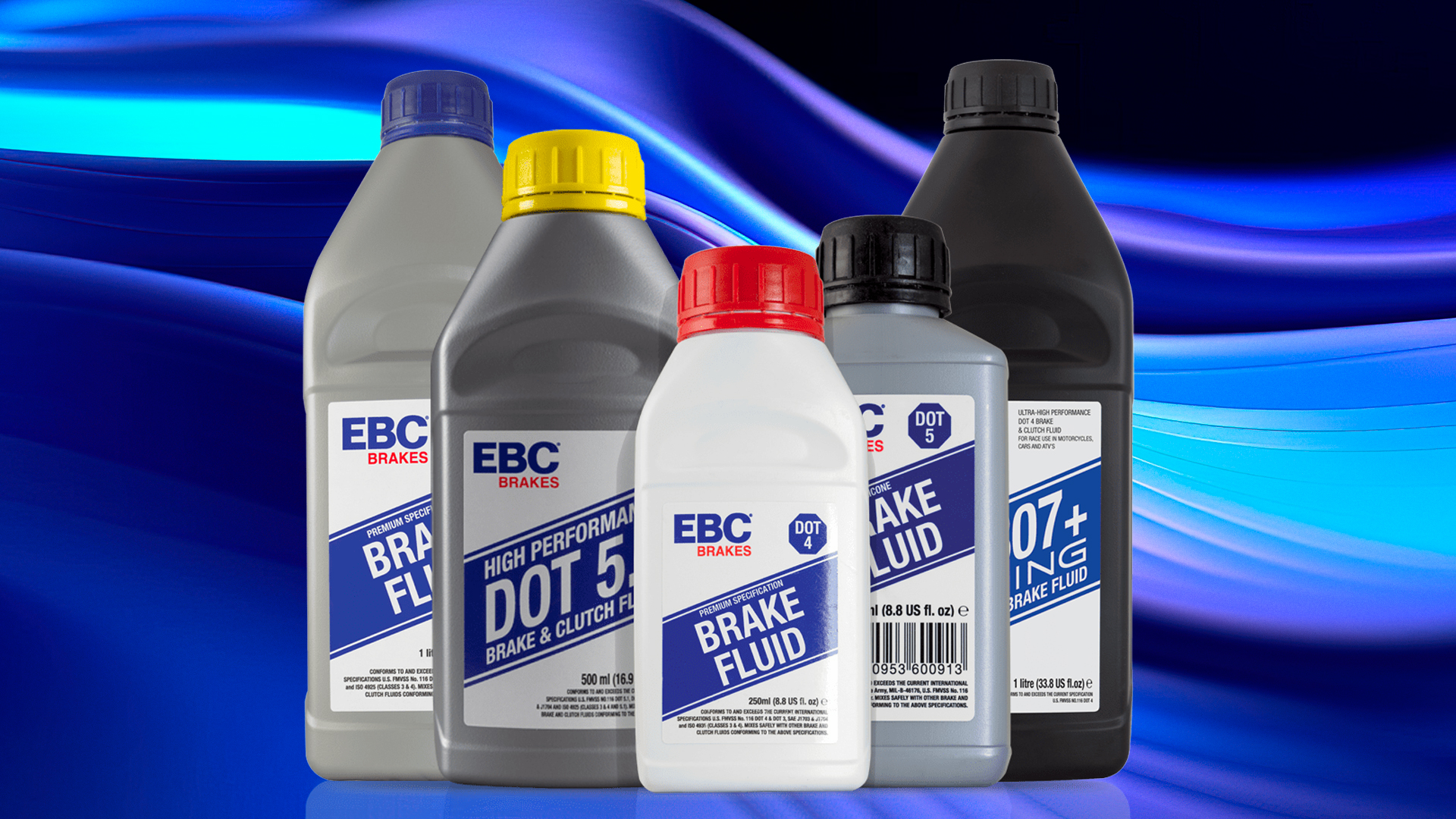
There are several different types of brake fluid: DOT 3, DOT 4, and DOT 5, as well as some subcategories. Generally, the lower the number, the lower the boiling point.
| Type | Material | Color | Dry Point | Wet Point | Use |
|---|---|---|---|---|---|
| DOT 2 | Mineral Oil | Translucent | 190 ºC | 140 ºC | Obsolete |
| DOT 3 | Glycol | Amber | 205 ºC | 140 ºC | Automotive |
| DOT 4 | Glycol | Light Yellow (reddish hues) | 230 ºC | 155 ºC | Automotive |
| DOT 5 | Silicone | Purple | 260 ºC | 180 ºC | Military |
| DOT 5.1 | Glycol | Amber / Translucent | 260 ºC | 180 ºC | Automotive |
DOT 2 Brake Fluid
DOT 2 brake fluid is rarely used in the automotive industry. It is produced based on mineral oil and has remarkably low wet and dry boiling points, making it quite useless. In fact, its dry boiling point is the wet boiling point of DOT 5 and DOT 5.1 brake fluids.
- Dry boiling point: 190 ºC (374 ºF)
- Wet or degraded boiling point: 140 ºC (284 ºF)
DOT 3 Brake Fluid

DOT 3 brake fluids are glycol-based and amber in color. They have the lowest dry boiling point, meaning their boiling point when new is low. On the other hand, when the fluid becomes damp, the boiling point remains relatively low.
- Dry boiling point: 205 ºC (401 ºF)
- Wet or degraded boiling point: 140 ºC (284 ºF)
Since DOT 3 is hygroscopic, it needs to be replaced every few years to maintain its effectiveness.
No products found.
DOT 4 Brake Fluid

European car manufacturers primarily use DOT4 as brake fluid.
European car manufacturers primarily use DOT 4 brake fluid. Although it is also glycol-based, it has a higher boiling point due to borate-ester additives that reduce acids formed by absorbed moisture.
DOT 4 usually costs twice as much as DOT 3 due to the extra chemicals. They perform better than DOT 3 fluids initially, but their boiling point ends up dropping rapidly in later stages.
- Dry boiling point: around 230 ºC (446 ºF).
- Wet or degraded boiling point: 155 ºC (311 ºF)
The use of DOT 4 oil is increasing in standard vehicles. It is most commonly seen in European cars. It comes in a few different classifications, such as low-viscosity DOT 4 and racing DOT 4, often colored blue instead of amber.
No products found.
Can DOT 3 be mixed with DOT 4?
If your car runs on DOT 3, you can mix it with or switch to a DOT 4 fluid without any issues. However, considering the price of the product, what is truly advisable is to flush the system completely and refill it with the new fluid. In many cases, switching from DOT 3 to DOT 4 will not provide a massive advantage either—provided that proper maintenance of the braking system is carried out—.
DOT 5 Brake Fluid

DOT 5 brake fluid is silicone-based and usually has a distinct purple hue. Its price is quite similar to that of DOT 4 fluid.
This specification has a high boiling point and does not absorb water like other types of brake fluid. DOT 5 does not work well in some braking systems because it becomes foamy and produces air bubbles that cause a spongy brake feel. Furthermore, since it does not absorb moisture, any liquid that enters the system rapidly corrodes it and contributes to freezing or boiling at unfavorable temperatures.
- Dry boiling point: 260 ºC (500 ºF).
- Wet or degraded boiling point: 180 ºC (356 ºF).
Due to its different properties, DOT 5 should never be mixed with other brake fluids. It is designed for vehicles that remain stored for long periods of time, such as military vehicles, and can function immediately when needed.
Despite its higher boiling point and anti-corrosive properties, car manufacturers avoid silicone-based brake fluid due to its low air content and lack of water solubility.
No products found.
DOT 5.1 Brake Fluid

DOT 5.1 has a boiling point similar to that of racing DOT 4 brake fluids. It is glycol-based and features a range of colors from light amber to translucent.
DOT 5.1 is basically a DOT 4 brake fluid, just with a chemical composition that allows it to comply with DOT 5 regulations.
- Dry boiling point: 260 ºC (500 ºF).
- Wet or degraded boiling point: 180 ºC (356 ºF).
Can 5.1 fluid be mixed with DOT 3 or DOT 4?
DOT 5.1 brake fluid is very expensive. It can end up costing up to 10 times more than DOT 3. However, due to its glycol composition, it can be mixed with DOT 3 and DOT 4 fluids.
That being said, we cannot mix it with DOT 5 for the reasons discussed in its corresponding section.
No products found.
Is there a standard like DOT in Europe? – Understanding ISO 4925

In Europe, there is a standard similar to the US DOT for brake fluids. It is known as the ISO 4925 standard. This standard is issued by the International Organization for Standardization (ISO) and has several categories that largely correspond to the DOT categories.
The most commonly used ISO 4925 standard classifications are the following:
- Class 3: has a minimum boiling point of 205 ºC (401 ºF), which corresponds to DOT 3.
- Class 4: has a minimum boiling point of 230 ºC (446 ºF), similar to DOT 4.
- Class 5.1: has a minimum boiling point of 260 ºC (500 ºF), similar to DOT 5.1.
- Class 6: is a low wet boiling point brake fluid standard and is less common.
Just like the DOT standard in the United States, ISO 4925 defines the physical and chemical properties that brake fluids must meet to ensure proper performance. However, it is worth noting that there is no exact correspondence between the DOT and ISO standards, and compliance with one does not automatically guarantee compliance with the other. Therefore, it is always recommended to use the brake fluid specified by the vehicle manufacturer.
Brake Fluid and Clutch Fluid: Are They the Same?

Often, confusion arises between brake fluid and clutch fluid in vehicles, as both are an integral part of hydraulic systems. The key question is: are they the same?
The short answer is yes, they are generally the same type of fluid: a glycol-based hydraulic fluid commonly known as DOT 3, DOT 4, or DOT 5.1 brake fluid. Both systems, the brake and the clutch, use this type of fluid due to its high boiling point properties and corrosion resistance, characteristics essential to ensure proper operation under extreme conditions.
In vehicles with manual transmission, it is most normal to find that the clutch and brake systems are shared. They are actually two independent systems, but they are filled from a single location. Each system uses its own master cylinders and has independent bleeders, but as we said, the fluid enters through the same opening.
What is the clutch fluid used for?
Clutch fluid plays a vital role in transmitting force from the clutch pedal to the transmission, allowing the driver to change gears smoothly. As with the braking system, it is essential that this fluid functions properly under high pressures and temperatures.
However, it is worth checking whether our car shares the fluid and whether or not it has the same reservoir. It may be the case that both systems are independent and we could run into problems if we do not perform proper maintenance on each system.
Precautions When Working with Brake Fluid

Despite all the benefits of brake fluid discussed throughout the article, it is worth remembering that this fluid is a rather hazardous chemical product. Therefore, it is important to take several precautions when working with it:
Avoid Contact with Skin and Eyes
Brake fluid can be irritating to the skin and extremely harmful to the eyes. You should always wear chemical-resistant rubber gloves and safety glasses when handling it.
Caution with Paints, Plastics, and Metals
Regardless of the type of brake fluid you use, this product is highly corrosive and can damage car paint and certain types of plastics. It can also accelerate the rusting of metal engine parts. Hence why it must be handled with extreme care. If spilled, you must clean it up immediately with soap and water.
Keep Out of Reach of Children and Pets
If a child or a pet accidentally spills this product, they can suffer severe burns or even get poisoned. Ingesting it can also have fatal consequences, which is why it is very important to store it safely and tightly closed.
Close the Container Tightly
Brake fluid is hygroscopic, meaning it absorbs water from the air. Keep the brake fluid in its original container and close it tightly after each use to prevent moisture absorption.
Recycling Brake Fluid
Do not dispose of used brake fluid on the ground or in the sewage system. It can be very hazardous and can destroy pipes or even alter the pH of the soil.
Used brake fluid or fluid we no longer plan to use must be taken to a clean point. If you cannot find one nearby, you can put it in a jug and go to a mechanical workshop to ask them the favor of keeping it. They should not give you any trouble.
Working with brake fluid requires careful handling and adequate protection. Always follow safety regulations and consult the vehicle manufacturer’s recommendations for brake fluid use and maintenance.