
Contents
The new revolution in the automotive industry is battery vehicles. There are defenders of pure lithium-ion battery electrics, while many industry experts take it for granted that we should not give up on the hydrogen fuel cell. In any case, electric cars are here to stay and will play a fairly important role from now on.
The current debate revolves around chargers and charging infrastructure. The scarcity of lithium and the difficulty of supplying electrical energy to cars—while keeping them sustainable—is a challenge we still must overcome. Although not many people know it, car manufacturers already experimented with electric cars in the past. And that is what we are going to talk about in today’s article.
Battery-powered cars, a repeating history

Gustave Trouvé’s tricycle (1881). The world’s first electric car.
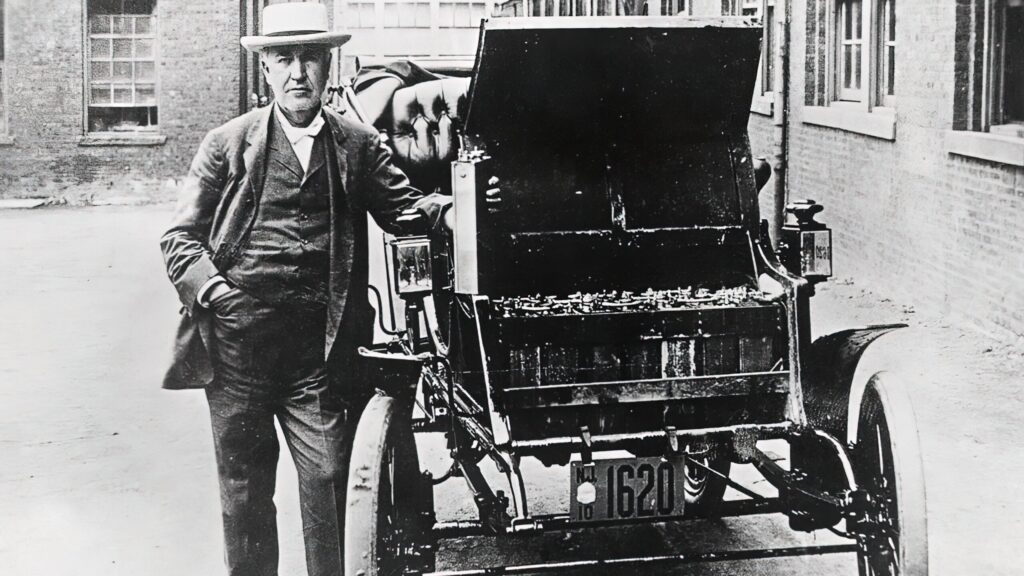
Electric automobiles are not a new technology. If we look back at the origins of motoring, we will find that this scenario we are experiencing today was already attempted back then. The first electric car prototypes date back to the early 19th century, coinciding to a certain extent with the development of the electric motor and the battery. Engineers in the United States and Europe made significant progress, but it took time for manufacturers to gain momentum.

New York Edison Company electric cars lined up in Manhattan. 1906.
In the 1890s, ten times more electric cars were sold than gasoline cars (and there were also steam-powered vehicles competing in the market). One of the main electric cars was a vehicle built in Iowa, designed by a chemist named William Morrison. Its top speed was approximately 22.5 kilometers per hour. It competed with brands like Studebaker and Oldsmobile, which also manufactured electric cars at the time. Their gasoline models would arrive, but a bit later.
Electric automobiles enjoyed a good boom until the turn of the century, but mass production proved to be their Achilles’ heel. When all cars were built by hand, the competition was even, but in 1910, the first modern assembly lines were introduced. Given that gasoline vehicles were the first to be mass-produced, their manufacturers gained a financial advantage that electric vehicle manufacturers could not overcome.

A Columbia electric car. 1899.
The limited electrical infrastructure was also a problem—this sounds familiar from the current landscape, doesn’t it?—. Thus, gasoline established itself as the preferred energy source, driven by the enormous popularity of Ford’s economical and affordable Model T. Electric vehicles continued to be manufactured, but in very small numbers, for commercial or industrial purposes. In the 1990s, there was a brief resurgence of electric cars, especially in commercial vans. However, they disappeared again before our current era of electric cars began.
Will this new phase work?

The current offering of electric cars is enormous. From a Peugeot subcompact to a Lucid luxury sedan. Electric range has also improved enormously thanks to the evolution of batteries, and it is now easier than ever to find a place to recharge.
However, given the way current EV manufacturers promote their achievements and modern technology, it is no surprise that the electric car seems like something completely new. It is essential to remember that this technology has more than a century of history and has evolved enormously since its beginnings. As innovation advances, we are likely to see an increasing adoption of electric vehicles, a more extensive charging infrastructure, and solutions to problems that were previously limiting.
The future of the electric car is promising, and although it is not a completely new technology, continuous improvements in performance, design, and accessibility are allowing more people around the world to join the electric vehicle revolution. Ultimately, this will help reduce polluting emissions and favor sustainable development in the transport sector.
The future will be sustainable or there will be no future

In any case, the current generation of electric cars has only just begun. It remains to be seen how the hydrogen fuel cell evolves, while also giving a chance to synthetic fuels, as they can end up being even more sustainable than battery-powered cars.
After all, scrapping a car and ending its useful life is also a polluting process. Hence, it is also interesting for the oil industry to develop new synthetic hydrocarbons that do not emit polluting gases into the atmosphere and allow older machines to continue serving their owners without emitting any type of harmful gas into the atmosphere.