
Contents
- Triplets: Toyota GT-86, Subaru BRZ and Scion FR-S
- Humble rings: Seat Exeo and Audi A4
- Three-phase: Seat Mii, Volkswagen Up and Škoda Citigo
- The enemy of my enemy is my friend: Citroën C1, Peugeot 107 and Toyota Aygo
- The tiny vans: Fiat Fiorino, Citroën Nemo and Peugeot Bipper
- If it passes, it passes: Renault Captur and Mitsubishi ASX
- Gyozas vs. Ravioli: Suzuki SX4 and Fiat Sedici
To the eyes of people who know nothing about cars, every single automobile on the street looks the same. However, for us gearheads, it’s quite fun to identify models that are the exact same thing.
Drawing on a personal experience, I remember I must have been about 5 or 6 years old when I realized one afternoon that the Seat Arosa and the Volkswagen Lupo were literally the same car. I arrived at my uncle’s house that very day with great excitement to tell him, and he explained to me that Seat and Volkswagen belonged to the same group, an answer that blew my mind even more. From that moment on, I started looking for more examples on the street. It didn’t take me long to realize that the Berlingo and the Partner were also the same van. However, it took me decades to notice other more far-fetched cases, like the Peugeot 806 and the Fiat Ulysse.
With the goal of making a fun and entertaining post, here are a few cases of badge engineering in the automotive field. Some are obvious, others are far-fetched… and there are also a few that are just pitiful. Let’s get into it.
Triplets: Toyota GT-86, Subaru BRZ and Scion FR-S

Making a sports car costs a lot of dough, and sometimes it’s also complicated to recover the investment. Toyota made it clear and teamed up with Subaru to split the check when manufacturing this sports car that is now in its second generation—and has now been renamed the GR-86—.
Same platform, same 4-cylinder boxer engine and rear-wheel drive. That said, each brand will tell you that its model is unique. If we listen to the marketing, the Subaru BRZ is the bad-boy sibling, as it is the sportiest and most aggressive. The GT-86 came out elegant and responsible. And finally, the Scion FR-S was the cheap sibling, more affordable and focused on the youth audience with Toyota’s entry-level brand. Of course, the latter was only sold in the United States.
Humble rings: Seat Exeo and Audi A4

If you’re going to copy, copy the best in class. The Audi A4 B7 was an A+ vehicle, so when it came time to recycle it to make a Seat, they didn’t try very hard to hide the fact that under the skin of the Spanish car was the German brand’s most famous sedan.
Seen in perspective, chapeau to the Volkswagen Group. Better an A4 dressed as a Seat than an old Clio dressed as a Dacia. You guys know what I mean.
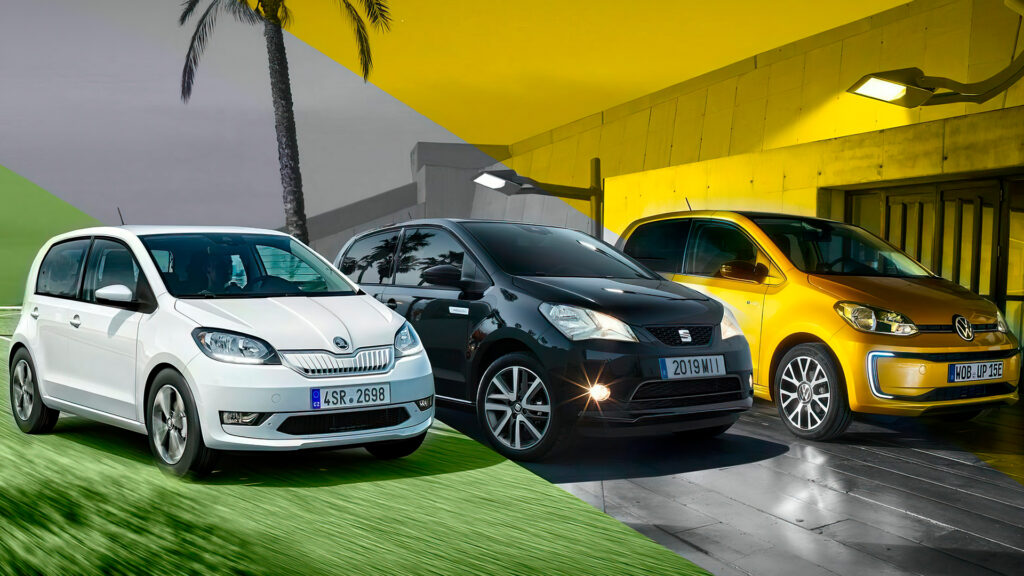
Three-phase: Seat Mii, Volkswagen Up and Škoda Citigo

Continuing with VAG, the Germans had to buy time to create their electric division. The Seat Mii, the Volkswagen Up, and the Škoda Citigo were a quick fix to weather the storm. They differed in the logo and little else. Although we didn’t care much either, because they were cool and continue to be fantastic vehicles for getting around the city with zero emissions.
The enemy of my enemy is my friend: Citroën C1, Peugeot 107 and Toyota Aygo

It wasn’t easy to stand up to Renault with the Twingo, Fiat with the 500, and Ford with the Ka. PSA and Toyota were clear about it and signed a marriage of convenience to release the Citroën C1, the Peugeot 107 / 108, and the Toyota Aygo to the market. All of them are very good cars, as they are exaggeratedly simple.
The most sought-after of this trio is the Aygo, simply because people think it’s truly Japanese. However, all of them were manufactured in the Czech Republic by Toyota Peugeot Citroën Automobile.
The tiny vans: Fiat Fiorino, Citroën Nemo and Peugeot Bipper

PSA and Fiat have done a lot of business together throughout history. So much so that they now even belong to the same conglomerate. Long before Stellantis was formed, the French and Italians came to the conclusion that there might be a market for a van smaller than the Doblò and the Berlingo. Thus were born the Fiat Fiorino, the Citroën Nemo, and the Peugeot Bipper, an absolute success.
If it passes, it passes: Renault Captur and Mitsubishi ASX

A rather sad case is that of the new ASX. The success of the Captur has led Renault to lend its design to Mitsubishi, the least fortunate member of their alliance. Unfortunately, they haven’t tried to hide in the slightest that it is badge engineering, which comes off as quite insulting, since the ASX was, until recently, a C-segment SUV. In short, so to speak, there is not even continuity with the model.
Gyozas vs. Ravioli: Suzuki SX4 and Fiat Sedici

A rather hidden case is that of the SX4 and the Sedici. Suzuki was looking to expand in Europe. Fiat, which knows a lot about this, accepted the proposal by releasing the Sedici, a car identical to the SX4, although adapted to the European market. If you didn’t notice, we won’t blame you either, as it is one of those vehicles that goes completely unnoticed.