
Contents
- History of VANOS
- What does VANOS mean?
- What does BMW's VANOS do and how does it work?
- Benefits of the VANOS system
- Disadvantages of the VANOS system
- How Double VANOS works
- What happens when VANOS fails?
- Rough idling
- Loss of torque and power
- Engine stalling
- Increased fuel consumption
- Limp mode
- What causes the VANOS system to malfunction?
- Does VANOS require any maintenance?
- Differences between VANOS and VTEC
You have probably heard of VANOS at some point, that mysterious technology used by BMW that many people don't even know whether their car has or not. In Spanish, it is often confused with the term vano motor (engine bay), which refers to the space under the hood of any car, although the two have nothing to do with each other. In this post, we will tell you everything you need to know about VANOS: what it is, why it was invented, what it does, and the advantages and disadvantages of this BMW solution compared to equivalent variable valve timing technologies found in competing brands.
History of VANOS

Starting in the 1990s, numerous manufacturers concluded that variable valve timing was the most appropriate path to achieve their goals of reducing fuel consumption and increasing power.
In 1992, BMW began fitting engines with this timing system in some variants of the BMW 5 Series. However, it was in the E36 3 Series where this variable valve timing system would reach widespread popularity.

Since then, the Bavarian brand has continued developing and refining this technology. Some of the shortcomings of the original VANOS were ironed out with its evolution, Double VANOS. The latter is a much more precise, powerful, and efficient assembly, as we will see in detail later on.
What does VANOS mean?
The term VANOS, coined by BMW for its vehicles, is an acronym derived from the German words "Variable Nockenwellensteuerung." In English, this translates to "Variable Camshaft Control."
What does BMW's VANOS do and how does it work?

VANOS is a variable valve timing system developed by the BMW Group. It is implemented both in its own vehicles and in cars from other brands, such as Mini, Land Rover, and even some PSA models (Peugeot, Citroën, DS…), among others.
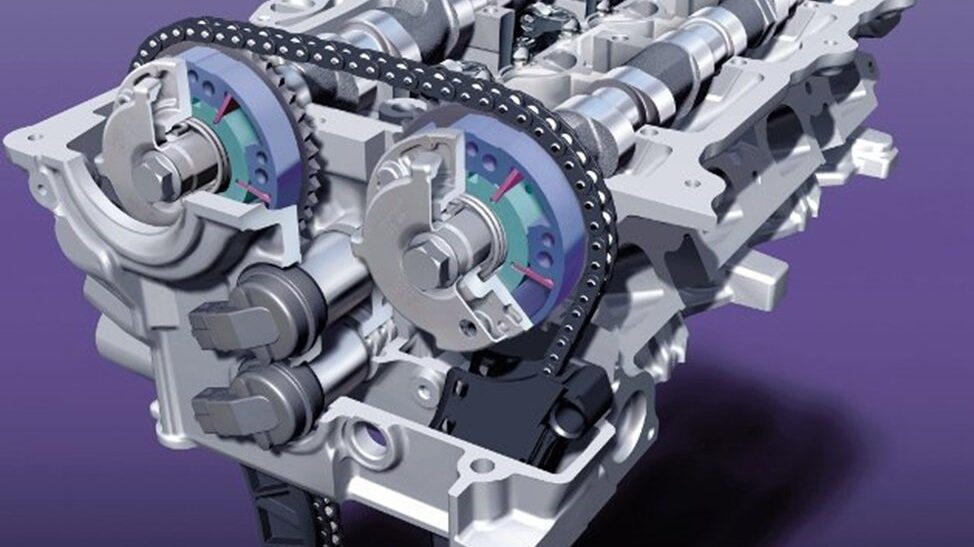
Whereas in a DOHC engine without VANOS, the timing belt transmits rotation directly to the camshaft, in a DOHC engine with VANOS, the timing chain is connected to the sprockets of the VANOS system.
In the first case, the faster the crankshaft rotates, the more frequently the valves open. In the second case, it is the VANOS and its assembly of gears and pistons that set the timing for the opening and closing of the valves.
Benefits of the VANOS system

The great reputation earned by VANOS is due to its efficiency and fuel consumption reduction. Below, we will describe how the single VANOS system translates into performance and efficiency across three different scenarios:
- When the engine runs at low RPM, the system opens the intake valves with a slight delay. This process results in lower fuel consumption when the vehicle is idling and smoother overall engine operation.
- When driving at a more moderate RPM range, the VANOS does the opposite of the first scenario and advances the opening of the intake valves. This slight phase shift makes it possible to achieve greater torque in the mid-range of the tachometer. It also allows for better exhaust gas recirculation within the cylinders, leading to a reduction in fuel consumption and lower harmful gas emissions.
- Finally, when the engine runs at high RPM, the VANOS system once again delays the opening of the valves. Although it might seem counterproductive, this allows the engine to make better use of the fuel, thereby maximizing power.
Another reason why the VANOS system performs so well in terms of engine torque is the fact that it delays the closing of the intake valves. This allows for better filling of fresh gases into the cylinders, resulting in an increase in engine torque.
We normally express both the maximum power and maximum torque of an engine alongside their corresponding RPM ranges (for example, BMW's N20B20 engine produces 180 hp at 5,500 rpm and $310\text{ N}\cdot\text{m}$ at 1,250 – 4,500 rpm). In this example, we can clearly see how VANOS operates. The power—that is, the 180 hp—would be generated in the third scenario, at a high RPM range. On the other hand, torque is developed in the mid-range, which corresponds to the second scenario we explained.
In summary, power is generated at the point where the engine spins fastest, regardless of whether the cylinders fill with less fresh air due to the shorter valve opening time. Conversely, torque is generated at the point where cylinder filling is most optimal.
Disadvantages of the VANOS system
One of the areas for improvement in the original VANOS system is its piston mechanism. With its two discrete positions—open and closed—it only allows the valves to be actuated across three specific RPM ranges, as mentioned in the previous section. Fundamentally, this also happens because it only acts on the intake valves. This gave rise to its evolution: the Double VANOS (or Dual VANOS) system.
How Double VANOS works

While single VANOS only manages the opening and closing of the intake valves, its evolution—which debuted with the 1997 BMW M3 E36 Evo—also acts on the exhaust valves.
Whereas the single system offers three-stage control, in Double-VANOS the camshaft timing is capable of optimizing power at any RPM, as it can continuously control all the valves.
Its operation is practically identical to the single system we discussed previously, except that by also controlling the exhaust gases, it achieves even more power at high RPMs as well as lower fuel consumption and emissions across the entire engine rev range.
What happens when VANOS fails?

As explained in the previous section, VANOS operates across the entire RPM range of the engine. For that reason, several issues will arise when the system fails.
VANOS failure symptoms vary depending on which component has failed and the severity of the breakdown. Here is a list of symptoms you might encounter if your VANOS fails:
Rough idling
It is a common misconception that VANOS is inactive when the engine is idling. That is not true. There is only a brief period of VANOS inactivity when you start the engine, which lasts for a specific number of camshaft rotations.
This brief window is used by the engine control unit (ECU) to evaluate the camshaft position, engine temperature, load, and other metrics, which it then uses to adjust valve timing to meet the engine's current needs. We are talking about mere milliseconds between the moment you start the engine and when the valve timing adjustments are made.
Because of this, any problem with the VANOS system can easily lead to rough idling issues, as the engine is not getting the proper timing adjustment after startup.
Loss of torque and power
One of the main benefits of variable valve timing is the ability to manipulate torque and power across the RPM range. Loss of torque and power is a well-known symptom of VANOS failure that is often caused by faulty seals. These seals are meant to maintain pressure within the system. Once they deteriorate, you will start experiencing a loss of power across the rev band, and the engine may also feel sluggish, especially at low RPMs.
It is worth noting that the loss of power and torque does not always happen suddenly. In many cases, it is a gradual process that takes place over time.
Engine stalling
Just like with rough idling, your engine may stall because your VANOS system is failing. Depending on the nature of the fault, the system might be too slow to adjust the engine timing, causing a sudden drop in RPMs and eventually a stall. This generally occurs during the winter, due to lower operating temperatures.
Increased fuel consumption
Your BMW's fuel consumption depends on several factors, one of them being the valve timing angles. Your engine effectively determines how long the intake (and exhaust, in the case of Double VANOS) valves remain open, thereby affecting how much fuel is injected into the cylinder.
A faulty VANOS system will essentially disrupt this optimal valve timing profile, causing the engine to burn more fuel than necessary.
Limp mode
Limp mode (or emergency mode) in your BMW is a safety feature triggered when the ECU detects a serious problem with the car. A faulty VANOS will not always put your car into limp mode, but it certainly can happen. The check engine light coming on is also common, especially in newer BMW models.
What causes the VANOS system to malfunction?

The causes of VANOS failure vary, but there are a few common culprits. Although worn seals are usually a primary factor, they are not the only components susceptible to wear. Over time, bearings and thrust washers can also wear out, causing the splined shaft to tilt and malfunction.
Another frequent cause is clogged oil lines. The VANOS system is very sensitive to oil quality. If oil changes are skipped, old and contaminated oil can cause trouble. The incorrect viscosity of degraded oil significantly affects the proper functioning of the VANOS unit.
Less common, though still possible, is a solenoid valve failure. If it gets stuck in an open or closed position, the VANOS system becomes inoperable. When this happens, itusually triggers the check engine light on the dashboard.
Every engine has its quirks, but these issues with seals, bearings, blockages, and the solenoid valve are universal causes of VANOS failure across BMW engines—as well as other manufacturers like PSA that also use this system in certain engines. Keeping the system clean and properly lubricated is crucial to preventing these avoidable breakdowns.
Does VANOS require any maintenance?

Although it was not originally designed as a regular maintenance item, the VANOS system does require a tune-up every now and then. Even if you perform your oil changes on time, there is a chance that your solenoid mesh filter screen may become dirty after tens of thousands of miles of use.
If the aforementioned symptoms start to appear, do yourself a favor and don't rush to replace parts right away. First, clean the solenoids. There is a good chance that cleaning them will solve your problems in just an hour.
That being said, faulty seals are the primary focus of preventative maintenance and should be replaced periodically. Most VANOS systems begin to fail after around 100,000 km (60,000 miles). The seals wear out, become brittle, and allow oil to leak past them. At that point, you have to choose between replacing the entire unit or rebuilding it. The decision will mainly depend on the type of damage to your VANOS. Of course, we recommend using 100% genuine BMW components—or upgraded aftermarket seal kits specifically designed to outlast the factory ones.
Differences between VANOS and VTEC

Just as BMW researched how to manage valve opening and closing to improve fuel economy and reduce harmful emissions, other manufacturers raced back in the 1990s to develop their own systems.
One of the variable valve timing systems to which VANOS is often compared is Honda's VTEC system, which was born around the same time. Unlike VANOS, which solves the problem by adding a complex, highly elaborate electro-hydraulic mechanism to manage every demand placed on the engine, the VTEC system achieves this through a much simpler mechanical method by utilizing modified cam lobes (switching between different cam profiles). Nevertheless, its operation yields very similar results. You can read more about the VTEC system in this post.