
Contents
Honda's VTEC is considered by many experts to be one of the best engines on the market today. It stands for Variable Valve Timing and Lift Electronic Control, and its effectiveness, efficiency, and performance live up to everything we expect from products created in the Land of the Rising Sun.
History of VTEC

The VTEC system was designed by an engineer in Honda's product design department, Ikuo Kajitani. He was tasked with the mission of surpassing competing JDM engines—namely Toyota, Nissan, and Subaru—in both power and efficiency.
However, those were not the only demands placed on Mr. Kajitani. He was asked to squeeze no less than 160 hp out of a 1.6-liter inline-4 engine, which would be a major milestone in its day. Essentially, those figures were chosen because they would achieve a ratio of 100 hp per liter, nearly 30% more power than the average among competitors.
The Human Body: The Inspiration That Sparked VTEC

Kajitani got to work on the mission entrusted to him and kept turning it over in his mind until he reached a breakthrough that would mark a turning point in automotive history. The Japanese engineer visualized an engine, with its camshaft and valves, and likened it to the human respiratory system.
Let's get back to engines. All standard internal combustion engines consist of a metal block and pistons that move up and down as a result of the combustion of fuel and oxygen... And that entire mixture is regulated by the camshaft, which controls fuel intake and exhaust gas expulsion. This whole assembly must move faster and consume more resources the harder the engine is pushed. It was this entire process that led Kajitani to realize that human beings function in the exact same way on a metabolic level.
When we are at rest, or not doing a very demanding activity, our heart rate is low. Our heart beats at a slow pace and distributes oxygen to all our organs so they can function properly, and we consume very little oxygen. Proof of this is that we breathe at a slow, steady pace. However, when we run or do intense exercise, our heart rate rises because our muscles demand more oxygen to oxidize more sugars and convert them into energy. That is when our breathing speeds up, and sometimes we even feel short of breath. At the pulmonary level, the lungs open up to take in a greater volume of air and supply as much oxygen as possible to the body. This process is known as "bronchodilation."
1989. The First VTEC Engine Arrives

So, if our body is smart enough to take in more or less oxygen depending on the task we are performing... why not apply that same idea to how an engine works?
The first VTEC engine was produced by Honda in 1989. It was the heart of the Integra. Honda's feat was so remarkable that, since then, it has won virtually 90% of automotive engineering awards.
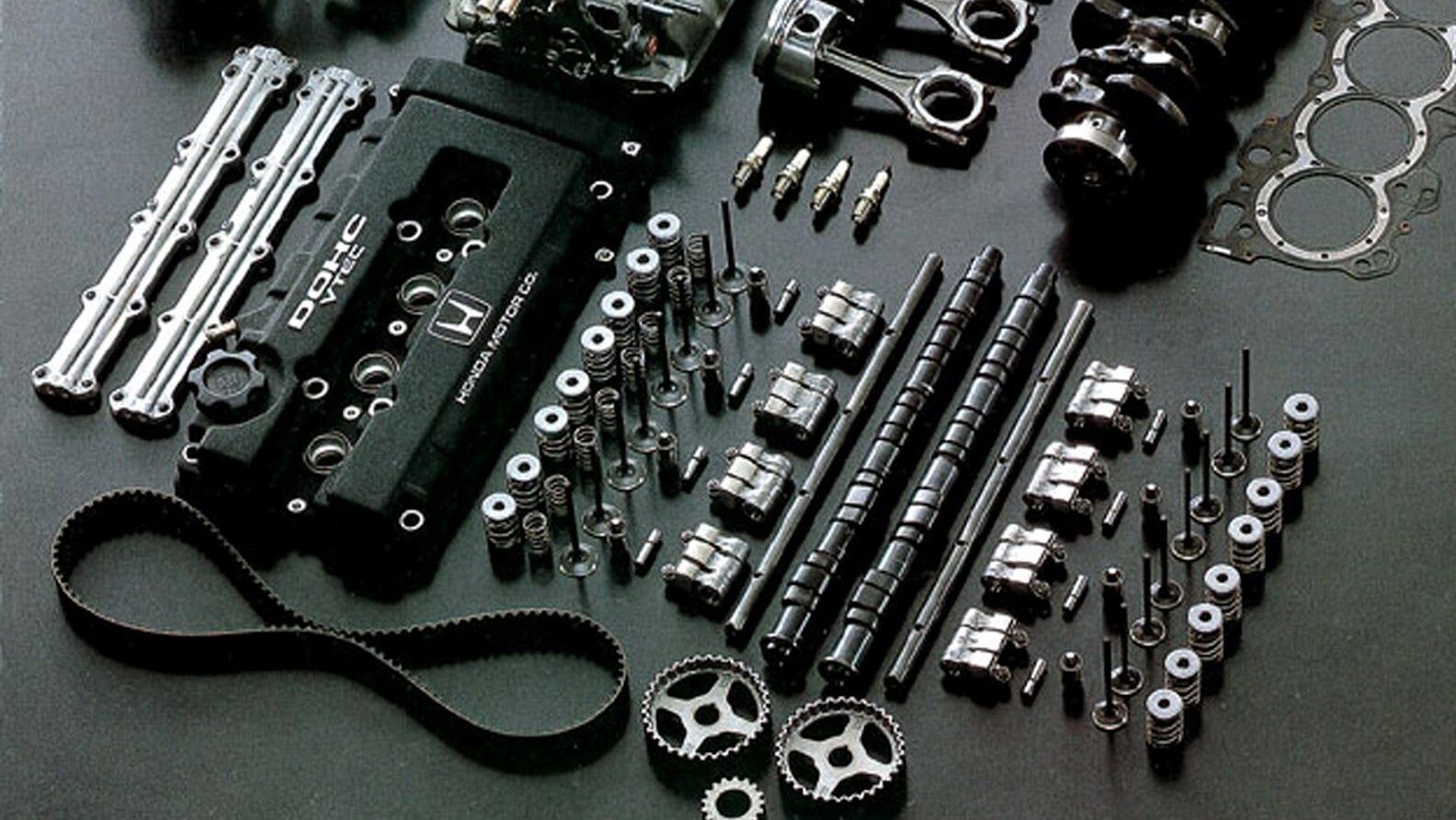
The engine, internally codenamed B16A, was a DOHC (Double Overhead Camshaft) unit. It would soon make its way into the Civic and the CRX, and was later applied to the V6 of the Acura NSX.

How the VTEC Engine Works
Just as we saw with other variable valve timing systems, the challenge for many engine manufacturers around the 1990s was to achieve maximum efficiency in internal combustion engines to reduce fuel consumption and harmful emissions. All of these manufacturers came to the conclusion that the best way to tackle this issue was to work on the camshaft.
The camshaft opens and closes the valves in the engine's cylinder head, allowing fuel and air to enter on one side while facilitating the exit of exhaust gases on the other. Naturally, because the cam lobes are fixed, regardless of the speed at which this process takes place, the opening and closing profile will always remain the same. In other words, the same set of valves will open and close in the exact same way every time.
Altering the Valve Timing
While in brands like BMW we saw that the way to manipulate the camshaft to our advantage was through an intermediate system, the VANOS, Honda came up with a much more Japanese solution—and therefore a simpler and more affordable one.
Each cam that makes up the camshaft in a VTEC system is triple-lobed. These three rotating pieces, called "lobes," come in two different sizes. In the center, there is a large lobe, and on both the left and right sides, there are two much smaller lobes.
Advantages of the VTEC Engine
At low RPM: Only the small lobes on the camshaft engage, opening the valves less and allowing for much better fuel economy.
At high RPM: The set of lobes locks together to form a single cam where the large center lobe sets the pace, unlike at low speeds. During this process, the valves open further and faster, allowing the engine to experience a massive, almost instantaneous boost in performance. This also produces a very distinctive and iconic sound specific to this engine, which has created legions of automotive enthusiasts who hold a deep admiration for these Japanese powerplants.
VTEC Engine Efficiency
Thanks to this simple mechanism, Honda's engine achieves tremendous versatility across numerous driving conditions. At low RPM, it is true that many competing engines match or surpass this technology, but at high RPM, Honda remains at the top of the leaderboard with a valve timing system that is as simple as it is effective.
The VTEC system does not use intermediate mechanisms, nor does it rely on components that drive up the final price of the car and are prone to wear and tear over time. That reliability, combined with the tremendous power delivery it develops at the top end of the tachometer, has made Mr. Kajitani's invention a true milestone in automotive history.
VTEC Engine Variations
As one would expect, over the more than 30 years since Honda launched this technology onto the market, numerous variations and evolutions of this engine have emerged. Some of the most important include:
i-VTEC
It stands for intelligent-VTEC. It combines the traditional VTEC system with another technology developed by Honda: VTC (Variable Timing Control).
It was introduced in 2001 across the inline-4 engine lineup. The VTEC system is paired with an electronic adjustment controlled by the vehicle's ECU, which allows valve opening to be retarded to improve performance and fuel economy at low RPM. Conversely, the system advances valve opening in the mid-range to improve engine torque.
i-VTEC i
Its operation is identical to the process described above, with the addition of a direct injection system. It was introduced in 2004 in the Honda Stream, equipped with a 2.0-liter DOHC gasoline engine.
VTEC Turbo
The evolution dubbed VTEC Turbo is an implementation created in 2014 as a more mature transformation of VTEC technology. Its standout features include the use of gasoline direct injection, turbochargers, dual overhead camshafts with VTC and VTEC, and improved exhaust gas scavenging to boost engine performance.
This technology also eliminates turbo lag, giving the driver greater precision over vehicle control and improving throttle response time. It debuted in the Honda Civic Type R and holds Euro 6 emissions certification, meaning this engine still has plenty of life ahead of it.