
Contents
Oil and rubber don’t usually get along well. When manufacturers first began installing timing belts back in the 1970s, they always kept this component well away from the oil pan.
Things changed a few years ago. The pursuit of more efficient and less polluting engines led manufacturers like PSA to build powertrains featuring a belt that operates in the exact same way as a chain. However, across the internet, you can read all sorts of negative comments about engines whose valve timing relies on an oil-bathed timing belt (also known as a wet belt). Are these exaggerations, or should we really avoid them?
What Are the Advantages of Wet Timing Belt Engines?
Both timing belts and timing chains have proven over the years to be highly reliable systems for managing intake and exhaust timing in internal combustion engines. You could say that a wet belt is essentially a belt pretending to be a chain, and here are its main advantages:
- Better fuel economy and lower emissions: The belt is very lightweight and generates less friction, resulting in 30% less energy loss compared to a timing chain. As a general rule, this is estimated to translate into fuel savings of slightly over 1%.
- Greater driving comfort: This system retains all the benefits of a dry belt, achieving lower noise levels, reduced vibration, and less harshness.
- Greater durability: On paper, manufacturers using these solutions set the belt replacement interval at every 10 years or 180,000 kilometers—slightly longer than a conventional dry belt.
Disadvantages of a Wet Timing Belt
In theory, an oil-bathed timing belt offers compelling advantages. However, the picture turns upside down once we start listing the disadvantages—and there are quite a few.
High Replacement Cost
When the scheduled replacement date arrives—or when the system starts causing problems—you will have to pay for a significant number of labor hours.
Replacing a wet belt involves dismantling numerous engine components and draining the oil. Consequently, the replacement becomes nearly as expensive as on a car equipped with a timing chain.
Belt Degradation and Failure
Using engine oil not recommended by the manufacturer can prove very costly in this type of vehicle. Typically, the automaker specifies the full specification for the type of engine oil that must be used.
Otherwise, oil acidity can eat away at the rubber. This is one of those situations we want to avoid at all costs. Recently, widespread issues have been seen with the PSA (Stellantis) EB engine, where the belt deteriorates with use—and poor maintenance—eventually clogging the oil filter and pickup strainer. In more extreme cases, a snapped timing belt can leave one of these engines completely ruined.
Which Brands Use Wet Timing Belt Engines?
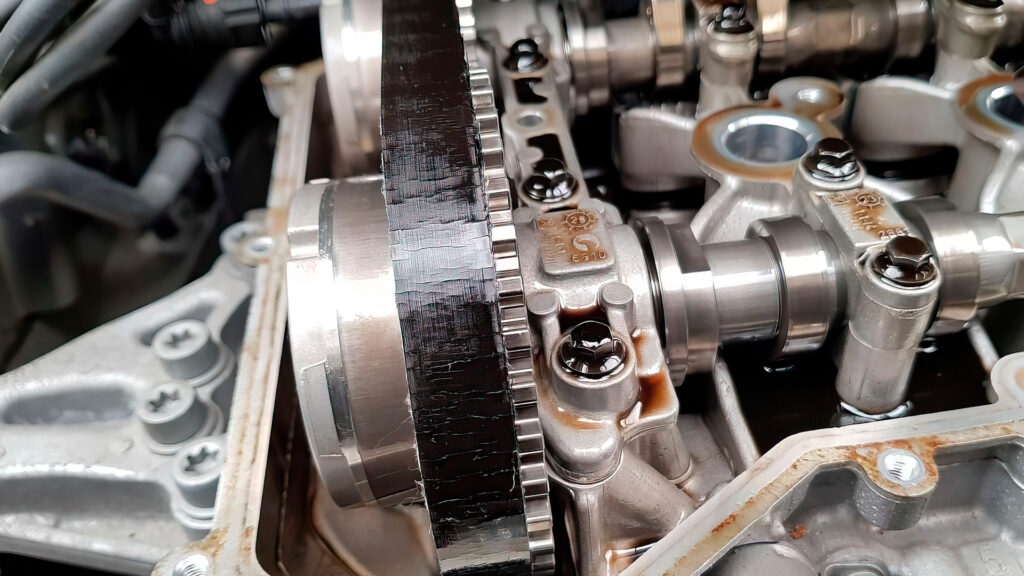
The PSA/Stellantis EB2 engine uses a wet timing belt system
The two main manufacturers that make use of this technology are PSA and Ford.
Unfortunately, some of the smallest and most efficient engines on the market use this type of belt. Ford’s EcoBoost gasoline engine lineup typically features this system in its smaller variants.
The wet belt is also found in PSA’s 1.2 PureTech gasoline engines, which appear across a wide variety of brands including Peugeot, Citroën, Opel, and DS Automobiles. These powertrains are also used in other Stellantis models, such as the Jeep Avenger. They can also be found in the Toyota ProAce City van, which is manufactured in collaboration with the French group.
Should I Avoid an Engine with a Wet Timing Belt?
There are already millions of cars around the world equipped with wet belts. There is no reason to avoid them at all costs, even though we consider them to have more drawbacks than advantages.
If you plan to keep your car’s maintenance up to date, don’t ignore oil changes, or are signing a lease for just a few years, don’t think twice—you shouldn’t have any problems. However, the timing belt issues in PSA (Stellantis) PureTech engines appear to stem from a design flaw rather than the belt itself. There is currently a group organizing a class-action lawsuit over the PureTech engine wet belt issues.
On the other hand, if you are the typical driver who completely neglects vehicle maintenance, we recommend looking for equivalent cars with simpler engines, such as those found in Toyota, Mazda, or even Renault, to name a few alternatives.